
Bocce Courts Contractors in Atlanta, Georgia
Atlanta is in our active coverage area — get matched with a vetted bocce courts contractor.
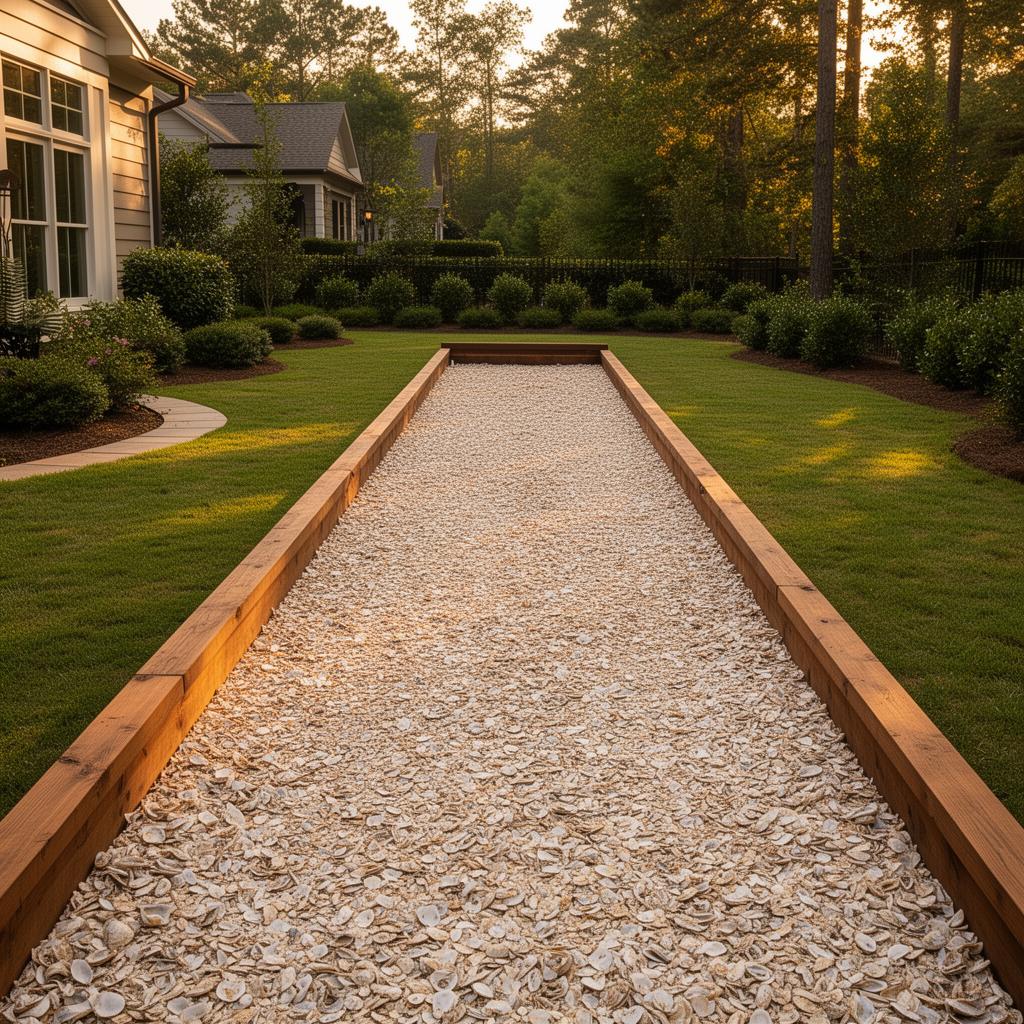
Crushed oyster-shell playing surface over a layered drainage base, hardwood rails, regulation 60 × 12 ft court.
A bocce court is won or lost below the surface. The courts that still roll true after ten Georgia summers are the ones built as a layered system: a compacted subgrade, a 4–6" crushed-stone structural base, a 2–3" decomposed granite leveling course, and a 1–2" oyster shell or bocce-blend playing surface, all contained by properly anchored side boards with drainage gaps. Our vetted Georgia contractors build to that standard — laser-set layout, mechanically compacted lifts, a 1% cross-slope for drainage, and hardwood or composite bumpers set to rebound consistently.
What a bocce court build includes
A regulation-quality residential bocce court is a five-layer assembly. Skip a layer and the surface telegraphs it within a season.
Regulation layout and dimensions Tournament bocce is 91 ft long by 13 ft wide. Most Georgia backyard courts run 60–76 ft long while holding the 10–13 ft width standard. Length can flex to fit your yard; width should not — anything under 10 ft removes the bank shots and strategy that make the game worth playing. Layout is set with a laser level so side boards are parallel, corners are square, and width is constant end to end.
Layer 1 — Compacted subgrade Native Georgia clay is stripped of organics and soft spots, graded, and mechanically compacted to a specified density. Differential settling in the subgrade is the single most common cause of a failed court, and it cannot be fixed from the top down.
Layer 2 — Structural base (4–6") Crushed aggregate, typically 3/4" minus / Class II road base, mechanically compacted in lifts. This layer carries load, distributes it away from the side boards, and doubles as a French drain that moves water laterally out of the court.
Layer 3 — Leveling course (2–3") Fine decomposed granite or stabilized aggregate that dials in precision flatness and keeps the fine playing surface from migrating down into the coarse base. Courts built without a leveling course need constant re-grading.
Layer 4 — Playing surface (1–2") Crushed oyster shell, oyster flour blends, or a proprietary bocce blend. It must be fine enough to roll smooth and binding enough to stay put — firm when damp, never concrete-hard, never dusty.
Layer 5 — Side boards and bumpers 2x6 or 2x8 boards containing 6–8" of layered material, anchored with galvanized stakes driven below frost depth, corrosion-resistant fasteners, a 1/2–1" drainage gap at the base, and a slight inward lean so balls rebound instead of riding up the board.
Weed barrier fabric is installed beneath the base layers, and compaction is verified with a plate compactor or vibratory roller at every lift — not hand tamping.
Base and ground materials, layer by layer Subgrade: native soil stripped of organics, graded, and compacted to 95%. Gopher control wire (galvanized 1/2 in mesh) is laid here on rural or wooded lots where burrowing is a risk.
Filtration fabric: a woven geotextile weed barrier is installed over the subgrade before any rock. It blocks weeds from pushing through the playing surface and keeps base fines from migrating into the soil. Seams overlap 6-12 in, so plan roughly 10% more fabric than court square footage.
Drain rock: 3-4 in of clean crushed 3/4 in drain rock (no fines) forms the drainage reservoir under the court and around any perimeter drain line. This is what keeps the surface firm after Georgia thunderstorms instead of going soft or rutting.
Class II road base: 4 in of crushed aggregate base compacted in two lifts is the structural layer. It carries loads, prevents settling, and holds the court dead flat over time. Budget about 1.5 tons of base rock per cubic yard of compacted volume.
Leveling course and playing surface: 1 in of screened fines to true the plane, then 2-3 in of compacted bocce blend or oyster shell blend as the finished surface.
Edging and containment systems Every court needs a rigid perimeter or the surface migrates and the court loses its shape. Options we specify:
Steel edging (Border King style): 1/4 in x 5 in heavy-gauge steel in 10 ft and 16 ft sections with tapered steel stakes, finished in black, brown, green, or weathering-steel patina. The cleanest architectural line, effectively permanent, and the best choice where the court meets lawn or planting beds.
Aluminum edging: lighter, rust-proof, easier to curve for radiused surrounds. Slightly less impact resistance than steel.
Timber side boards: teak, ipe, or pressure-treated ground-contact lumber at 6-12 in tall. Traditional look and the only option that gives you true bank-shot rails.
Masonry or concrete curb: highest cost, highest longevity, and the right answer when the court is integrated into hardscape, seat walls, or a pavilion.
Order edging by court perimeter: 2 x (length + width), plus 10% for corners, stakes, and cuts.
How a bocce courts build runs
From first call to first volley — most residential projects land in 8–14 weeks once permits clear.
- 01Site walk + layoutWeek 1Contractor confirms footprint, soil and drainage conditions, access, and final court dimensions with a laser-set layout.
- 02Excavation + subgradeWeek 2Strip organics, remove soft spots, grade to a 1% cross-slope, and mechanically compact the subgrade to specified density.
- 03Drainage + baseWeek 2–3Weed barrier, optional perforated drain pipe, then 4–6" of crushed base compacted in lifts.
- 04Side boards + bumpersWeek 3Boards set plumb and parallel, anchored with galvanized stakes below frost depth, with a 1/2–1" drainage gap and slight inward lean.
- 05Leveling + playing surfaceWeek 42–3" DG leveling course screeded flat, then the oyster shell or bocce blend surface installed damp, compacted, and rolled.
- 06Surround + handoffWeek 4–5Walking band, lighting, cleanup, then a care walkthrough covering brushing, watering, and annual topdressing.
Will your yard work?
Bocce is one of the most yard-friendly courts we build, but a few site conditions drive cost.
Footprint Plan for the court plus 3–4 ft of walking surround. A 12 x 70 ft court wants roughly 18 x 76 ft of usable area. Sloped lots are workable but need retaining or a stepped pad.
Grading and drainage Courts are built with an imperceptible 1% cross-slope so surface water sheds to the sides and into the permeable base. On Georgia red clay, heavy-clay soils, or a high water table, we add perforated drain pipe in the base layer routed to a daylight outlet — it adds cost and eliminates the chronic soft spots and erosion that ruin courts.
Access The base and surface materials arrive by the ton. Gate width, overhead clearance, and equipment access for a skid steer and plate compactor are checked on the site walk.
Trees, roots, and irrigation Root pruning, irrigation reroutes, and downspout redirection are identified before excavation. Runoff aimed at a court edge will undercut it.
Surface & color options
The playing surface sets ball speed, roll consistency, and how much upkeep you sign up for.
Oyster shell / oyster flour blend The competitive standard. Crushed shell blended with decomposed granite fines tightens the surface and gives excellent ball control and a fast, predictable roll. Premium look, premium price, benefits from regular brushing and light watering.
Bocce blend surface Engineered blends built to compact tightly while still draining. Excellent compaction, consistent roll, and the best all-round pick for backyard and club-level Georgia courts.
Decomposed granite Very good compaction and good drainage at the lowest cost. Great for recreational and practice courts; slightly slower and less refined than a shell blend, and needs periodic topdressing.
Artificial turf bocce A short-pile sand-filled turf over the same engineered base. Lowest maintenance and clean year-round appearance, with a slower roll than a mineral surface.
Surface blend colors and finishes Engineered bocce blends are specified by color as well as performance, so the court can be matched to your hardscape and shade conditions.
Golden pearl blend — warm honey-tan, the most common backyard finish and the easiest to keep looking clean under Georgia pollen and clay dust.
Grey pearl blend — cool neutral grey that pairs with bluestone, charcoal pavers, and modern architecture. Hides shoe scuffing well.
White pearl blend — brightest option, reads almost like crushed shell in full sun. Highest ball contrast, and the most sensitive to organic staining under tree cover.
Red pearl blend — classic clay-court look reminiscent of European courts. Warm under direct sun and very forgiving on maintenance color-wise.
Black pearl blend — dramatic dark surface with maximum contrast against white or ivory bocce balls. Runs hotter in July, so it is best on partly shaded courts.
Traditional pure oyster shell — no aggregate blending, just graded shell. The most authentic tournament finish, fastest roll, and the highest upkeep of the group.
Particle size and lift depth Playing surfaces are placed over the compacted leveling course in thin lifts, typically two passes of roughly 3/4 inch to 1 inch each, compacted and screeded between passes. Fines matter more than color: a blend with too few fines will never lock up, and a blend with too many will crust and shed water instead of absorbing it.
Maintenance by surface Shell and shell-blend courts want a drag brush after play, light watering in dry stretches, and a roller pass every few weeks in season. Straight decomposed granite courts need a topdress and re-roll roughly every one to two years. Turf courts need only sweeping and periodic infill leveling.
What not to use Pea gravel belongs in decorative surrounds, never on the court — it will not compact and the roll is unplayable. Mason sand, play sand, and unwashed screenings are also poor choices: they migrate, rut, and hold water.
Material quantities at a glance Surface blends are sold by the ton and compact at roughly 1.4 tons per cubic yard. A 13 x 91 ft tournament court at 3 in deep needs about 11 cubic yards, or roughly 15-16 tons of finished surface. A 12 x 60 ft backyard court at the same depth needs about 6.7 cubic yards, or roughly 9-10 tons. Use the material calculator on this page to size your own footprint, base rock, edging, and fabric before you talk numbers with a builder.
Popular add-ons
Bocce courts are built for evenings and entertaining, so most Georgia projects add at least two of these.
Side board upgrades Natural teak, ipe, or redwood — rot-resistant, authentic, and good for 15–25 years with periodic sealing. Composite and PVC bumpers eliminate sealing and resist warping; only exterior ground-contact-rated grades are used.
Steel or aluminum edging Contains the surface, holds crisp court lines, and stops material migration on the surround side.
Lighting Low-glare LED pole or bollard lighting for night play, plus optional string-light spans over the surround.
Surround and hardscape Flagstone or paver walking bands, seat walls, pergolas, and a scoreboard nook turn the court into an outdoor room.
Court care kit Bocce rake, drag brush, and a lawn roller — the three tools that keep a shell or DG surface rolling true.
Also popular Landscape screening, a covered ball-and-tool cabinet, and adjacent putting green or fire pit build-outs.
Bocce court material calculator
Set your court footprint and surface depth to see how much base rock, surface blend, edging, and fabric your build needs in Atlanta. Estimates use a 1.4 ton-per-cubic-yard compacted density and Georgia delivered material pricing — your builder confirms exact quantities after the site visit.
Recommended: 3″ compacted playing surface.
- Playing area
- 720 sq ft
- Surface volume
- 6.7 yd³
- Surface blend
- 9.3 tons
- Perimeter edging
- 144 lin ft
- Class II road base
- 13.3 tons
- Filtration fabric
- 792 sq ft
Surface blend only. Excavation, base rock, edging, fabric, drainage, and labor are quoted in your full court estimate. Add roughly 720 lbs of oyster shell top dressing if you want tournament-speed roll.
Design your bocce courts in Atlanta — email the estimate summary.
Pick your size, add upgrades, and save the setup when you're ready. We'll show the estimate after capture and confirm final pricing after a free on-site walk with a vetted Atlanta contractor.
Base Court
- Crushed oyster shell playing surface
- Wood-frame perimeter walls
- Engineered drainage base
- Bocce ball set
Court Size
Upgrades
Bocce Courts in Atlanta — FAQ
Straight answers about cost framing, timelines, surfaces, and what to expect on a Georgia residential build.