
Shuffleboard Courts Contractors in Marietta, Georgia
Marietta is in our active coverage area — get matched with a vetted shuffleboard courts contractor.
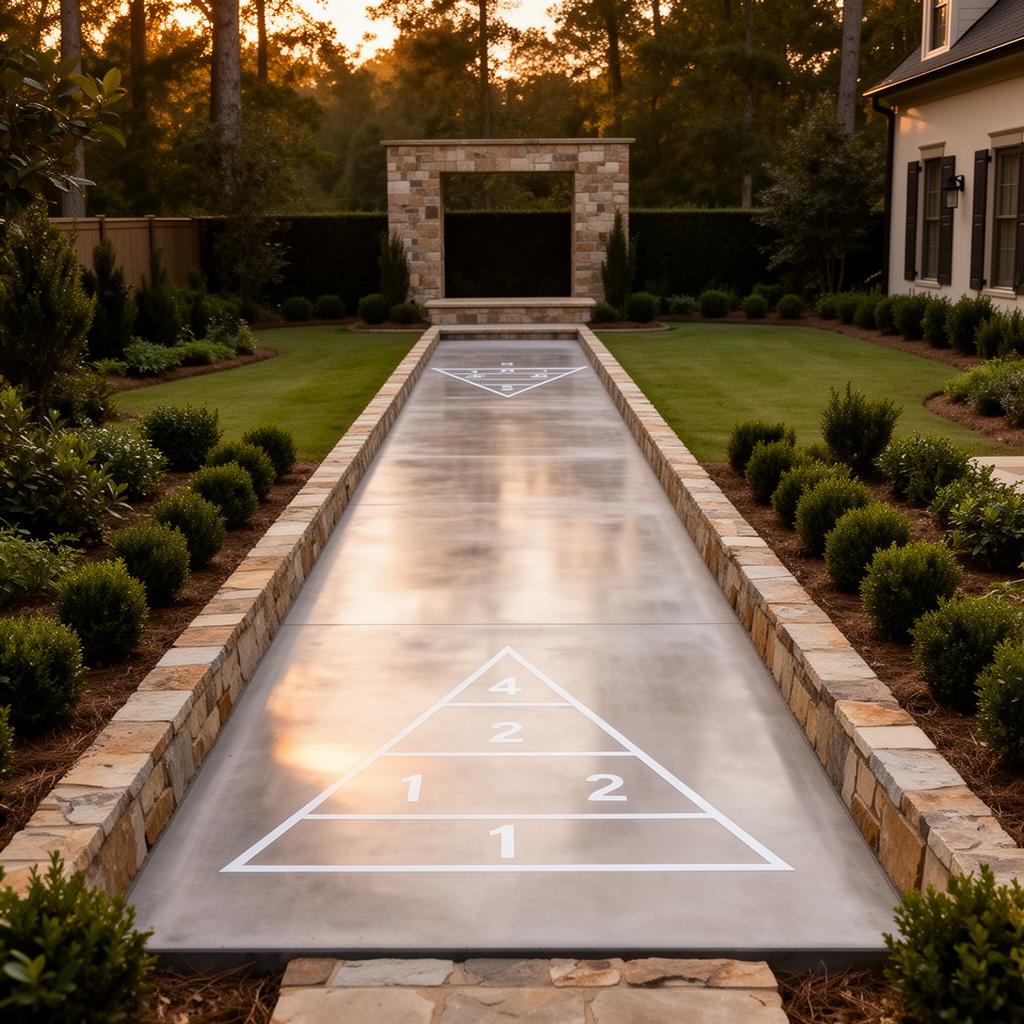
Polished concrete playing strip with sealed scoring triangles, stone perimeter, regulation 52 × 6 ft layout.
Outdoor shuffleboard courts start with the same foundation: an engineered, level concrete slab with proper base, slope and drainage. From there you choose the playing surface - a steel-troweled painted court with regulation scoring triangles, numbers and edge bumpers, or a modular interlocking sport-tile floor installed over the slab. Painted concrete gives you the classic fast, waxed glide and the longest life; sport tile is installed by our crew with molded-in white game lines, perimeter ramps and a perforated honeycomb base that drains after rain and never needs waxing or recoating. Tile comes in 15 standard and specialty colors for the playing area, outer area, border and ramps, and courts are sized single (6'4" x 52'4"), regulation-wide (10'4" x 52'4") or double court (16'4" x 43'4"). Every build includes site prep, base, slab, layout and regulation striping - we confirm slab condition, slope and drainage during the site review.
What a shuffleboard court build includes
Outdoor shuffleboard is the highest-play-value-per-dollar project in a Georgia backyard. It needs a narrow strip of level ground and almost no maintenance, and it fits alongside a patio, pool deck or bocce court.
**Common footprints:** backyard court 6' x 39' - regulation single 10' x 52' - double court 16'-20' wide. Pre-sized modular sport tile shuffleboard kits are offered at 6'4" x 41'4", 6'4" x 52'4", 8'4" x 41'4", 10'4" x 52'4", and double-court layouts up to an official regulation 20'4" x 55'4".
Every hard-surface court we quote in Georgia is built in the same five stages. What changes between a $18k pickleball court and a $60k tennis court is the size of the footprint, the depth of the base, and the surface system on top.
1. Layout, grading and drainage The contractor lasers the footprint, confirms setbacks and access for equipment, strips organics, and cuts the pad to grade. Georgia clay holds water, so the pad is built with a 1% planar slope in one direction — never a crown — and edge drains or a French drain are added where the yard sheds toward the court.
2. Structural base 4"–6" of graded aggregate base compacted in lifts to 95% density. This is the single most important cost line on the job: a court that cracks almost always failed in the base, not in the coating.
3. Slab or asphalt pad Post-tensioned or fiber-reinforced concrete (typically 4"–5") or 2"–3" of plant-mix asphalt. Concrete is the Georgia default for backyard courts because it tolerates our freeze/thaw and heavy rain cycles and can carry a modular tile surface later without rework.
4. Surface system Either an acrylic system — primer/sealer, acrylic resurfacer, two textured color coats, then textured white line paint — or a modular interlocking sport tile court kit laid over the cured pad. Acrylic gives the classic tour look; sport tile gives instant drainage, zero recoating, and a DIY-friendly install.
5. Lines, equipment and perimeter Game lines to governing-body spec, then posts, nets, hoops or backstops set in sleeves or footings, followed by fencing, netting, windscreens, lighting and landscape restoration.
How a shuffleboard courts build runs
From first call to first volley — most residential projects land in 8–14 weeks once permits clear.
- 01Design + approvalsWeek 1Site walk, laser layout, surface and color selection, HOA or permit package submitted.
- 02Excavation + gradingWeek 2Strip organics, cut to grade, install edge drains, set the 1% planar slope.
- 03Base + drainageWeek 2-3Graded aggregate base placed and compacted in lifts, drainage tied out.
- 04Slab or asphalt padWeek 3-4Concrete placed, finished, and cured (28 days for full acrylic cure schedules) or asphalt placed and rolled.
- 05Surface systemWeek 5Acrylic primer, resurfacer and two color coats, or modular sport tile kit installed from the numbered layout map.
- 06Lines, equipment, perimeterWeek 6Game lines to spec, posts/hoops/nets set, then fencing, netting, lighting and landscape restoration.
Will your yard work?
**Space:** confirm the full pad plus a safety run-out on all sides. For a modular sport tile court kit, the pad must extend at least 2" past the finished kit dimension on every side so the tiles can expand and contract seasonally.
**Slope:** up to about a 3' fall across the pad can be absorbed with grading; beyond that you are into retaining walls or engineered fill, which is where budgets move.
**Base condition:** sport tile can only go over a solid, level surface — new or existing concrete or asphalt. It cannot be installed directly on gravel, compacted stone, or bare ground.
**Existing courts:** a cracked or faded slab is usually the cheapest court you will ever own. Crack fill plus an acrylic resurface, or a sport tile kit laid straight over the old surface, both avoid new concrete entirely.
**Access:** a 9'-wide path for a skid steer and concrete truck reach. Pumping concrete over a house adds cost.
**Permits and HOA:** most Georgia municipalities treat a backyard court as an impervious-surface addition. Expect setback review, impervious-coverage limits, and HOA architectural approval before build.
Surface & color options
**Painted concrete court.** The traditional build: steel-troweled concrete slab, painted scoring triangles and numbers, edge bumpers, and shuffleboard wax (silicone beads) to control glide speed. Fastest surface, needs sweeping and periodic re-waxing. An epoxy mirror finish can be added over the painted concrete for an even faster, glass-smooth glide.
**Modular sport tile flooring.** Interlocking sport tile with standard white game lines and perimeter ramps, installed by our crew over the level concrete or asphalt pad using an interlocking system with integrated expansion bumpers. The honeycomb support structure keeps the surface even so discs glide consistently, and over 1,500 perforations per tile clear water quickly after rain. Choose your playing-area color plus optional outer-area, border and ramp colors from 15 standard and specialty colors. Sport tile is the low-maintenance choice: nothing to wax, nothing to recoat.
**Base requirement for tile.** The pad must be solid and level - new or existing concrete or asphalt - and extend at least 2" beyond the finished court dimensions on all sides for seasonal expansion. Tile cannot be installed directly over gravel or compacted stone.
Popular add-ons
- Sport tile kit in single, wide-regulation or double-court layouts - Custom playing-area, border and perimeter-ramp colors - Extra non-standard game lines or a custom center logo - Tournament cue and disc set with weatherproof storage cabinet - Integrated bench seating along one rail - Shade pavilion or pergola over the court - Low-glare LED court lighting and bistro string lighting - Manual flip scoreboard, paver walking band, landscape surround
Design your shuffleboard courts in Marietta — email the estimate summary.
Pick your size, add upgrades, and save the setup when you're ready. We'll show the estimate after capture and confirm final pricing after a free on-site walk with a vetted Marietta contractor.
Court Surface
Base Court
- Site prep, grading, and compacted base
- Engineered concrete slab built to host either surface system
- Edge containment and drainage slope
- Ready for painted court striping or modular tile flooring